You can't fix what you can't see.
An independent outside review of how your operation is actually run.
Three to five days on site, depending on the size of the operation. A private conversation with everybody from the newest hand up to the person running it. Then a written report on what is actually happening, what it is costing you, and what to do about it.
One report, one debrief. The fee is agreed in writing before I arrive and does not move.
Select Water Solutions · Florida Energy Services
What your reports say and what is happening are not the same thing.
Too much of this place runs through one person.
I don't have anyone ready to step up.
My best hands became supervisors and they are struggling as bosses.
What I hear in the office isn't what's happening in the field.
We keep losing good people and nobody can tell me why.
The safety numbers look fine and I don't believe them.
Critical knowledge sits in one head, with no apprentice behind it.
We have just put a new management team in and I need to know what I have got.
None of it shows up as a line on a report. It shows up as rework, as turnover in the roles you can least afford to lose, and as decisions made on information that was already stale.
Your supervisors were promoted for the wrong reason, and nobody trained them.
Of frontline supervisors were promoted for performance in a frontline role. Only 30% for supervisory skill or experience.
Gallup, 2025. 1,214 US frontline supervisors, nationally representative.Have never had any supervisor training at all.
Gallup, 2025. Same study.The fall since 2020 in employees who know what is expected of them at work. The largest decline Gallup measures.
Gallup, 2025. 78,945 US employees.You did not promote the wrong people. You promoted your best hands, which is the only sensible thing to do, and then the job changed under them and nobody told them how. That gap is not visible from an office, because the people living in it do not raise it with the person who promoted them.
There is nothing I can recommend that I would be paid to deliver.
No training program, no software, no licensed instrument, no implementation arm. The report can conclude that two of your five sites need nothing, which is a conclusion no firm that sells a rollout can reach.
Four things you can check before you call.
Your newest hire gets the same private hour as you do
Most assessments interview managers one to one and put the workforce in a group room with their supervisor present. People say different things in a group. Everybody here gets the same confidential conversation, which is why the findings are different.
One person does every interview and writes the report
The same observer at all five sites. So when three of them produce the same complaint you learn it is one cause, not five local personality problems, which is the question you cannot answer from where you sit.
I have nothing to sell you afterwards
No program, no software, no retainer. There is no problem I am looking for because I happen to fix it, and no reason to be polite about the one I find.
The price and the length are fixed before I arrive
The only thing that moves the fee is how many days I am on site, agreed in writing beforehand. The scope cannot grow into a program, and the fee cannot grow with the size of what I find.
I will also tell you if the dependency is you. Most owners already suspect the business could not survive losing them and have never been made to look at it squarely.
A week on the ground. Then this.
A written report of around sixteen pages, delivered to you and talked through in person. Two of those pages are below.
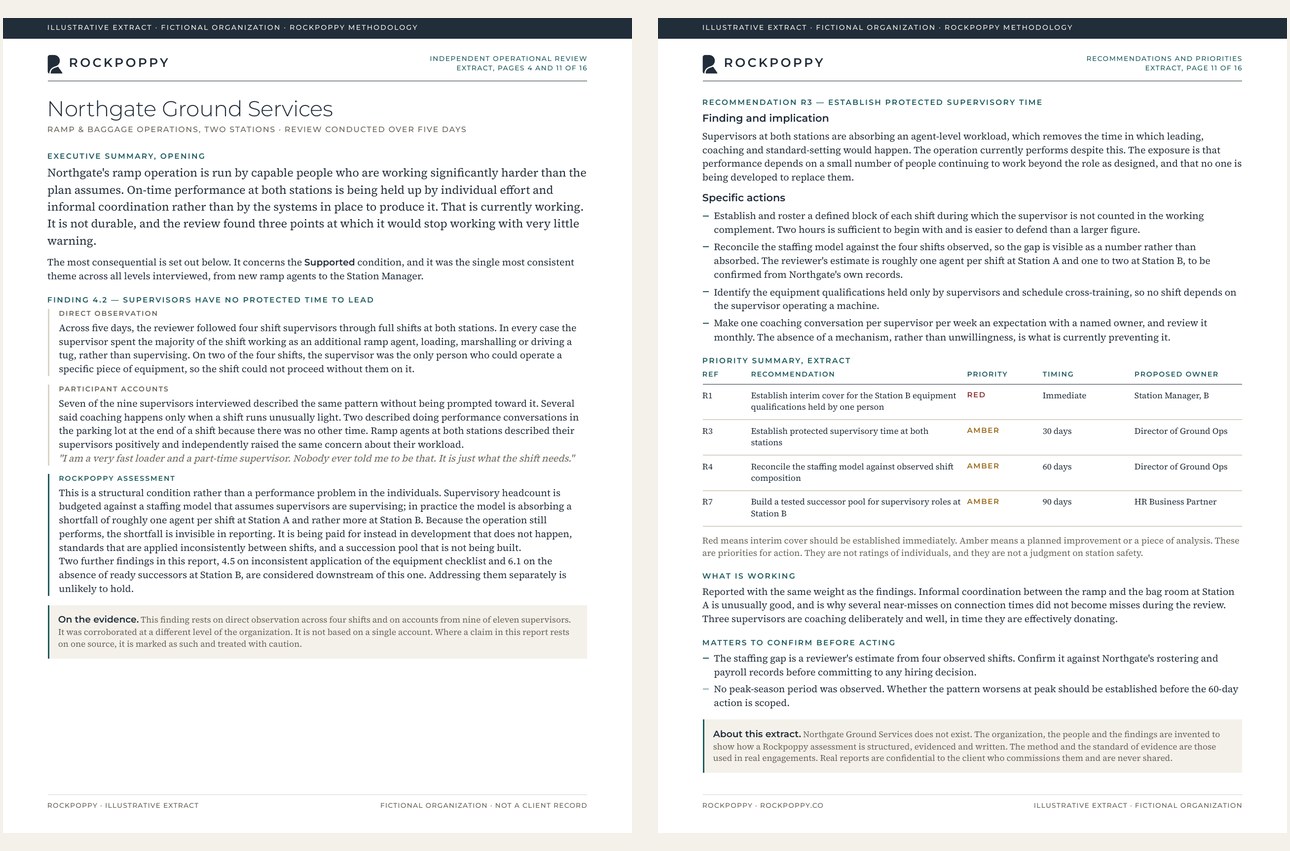
Evidence, separated
What was seen, what people said, and what Rockpoppy concludes, never collapsed together.
Priorities, not a list
Red and amber, each with a timeframe and a proposed owner.
What is working
Reported with the same weight as what is not.
Rockpoppy does not need to be expert in your operation. You already have those people. The job is to find out how they lead it.
Three steps, and the first one costs nothing.
- 1
A conversation
Twenty minutes on what you are trying to understand. No pitch.
- 2
A week inside one operation
Private conversations at every level, from the newest hire to the person running it.
- 3
The report, then a debrief
Findings, priorities and owners, delivered to you and talked through with your leadership.
Who this is for
The person who owns the P&L across more than one site. Chief operating officer, VP of operations, general manager, division president, regional director of operations. In a company of 60 people that is the owner. In a company of 500 it is usually one layer below.
Operating companies of roughly 20 to 600 people, where the work happens in yards, on sites, on shop floors, at terminals or back of house.
Who Rockpoppy has done this for.
Select Water Solutions
NYSE-listed water solutions company. Three operating regions reviewed, plus a leadership session in Dallas.
Florida Energy Services
Heavy civil and energy contractor on a federally funded infrastructure program.
More than 50 people interviewed, across more than 20 locations.
Two clients, both still trading, neither sold anything further. The work is confidential, so the sample report is a fictional operation built on the real method.
Findings stay confidential. Both companies agreed to be named.
In his words.
Your superpower is your ability to get people you don't even know to open up to you in a short time.Shane Donnelly
President of Operations, Poly, Containment and Fluid Handling
Select Water Solutions
Gregg has been a great unbiased sounding board.Shane Donnelly
Written to two external chief executives, October 2026
Gregg McLeod

British, direct and not corporate. As comfortable in a maintenance shop as in a boardroom, and able to get people at every level to say how things really work.
A British Army officer for thirteen years, which is where the habit came from: go and see for yourself, ask the people doing the job, and keep what you saw separate from what you were told.
Want a straight answer about your own operation?
Twenty minutes, no pitch. Tell Gregg what you are trying to understand.